New keyword infer to intentionally identify a known inferable type #36450

Description

Search Terms
infer
Suggestion
Add the possibility to type a variable with const myValue: infer = complexThing;
Use Cases
This solves the problem of having to disable the line with eslint/tslint if the rule typedef is intentionally activated
Examples
(only one example)
I have created a very complex smart class that deeply infers column-names for a table.
The class member table is now a very huge type and therefore I dont want to type it.
But I also dont want to write table: any or table: unknown
Details
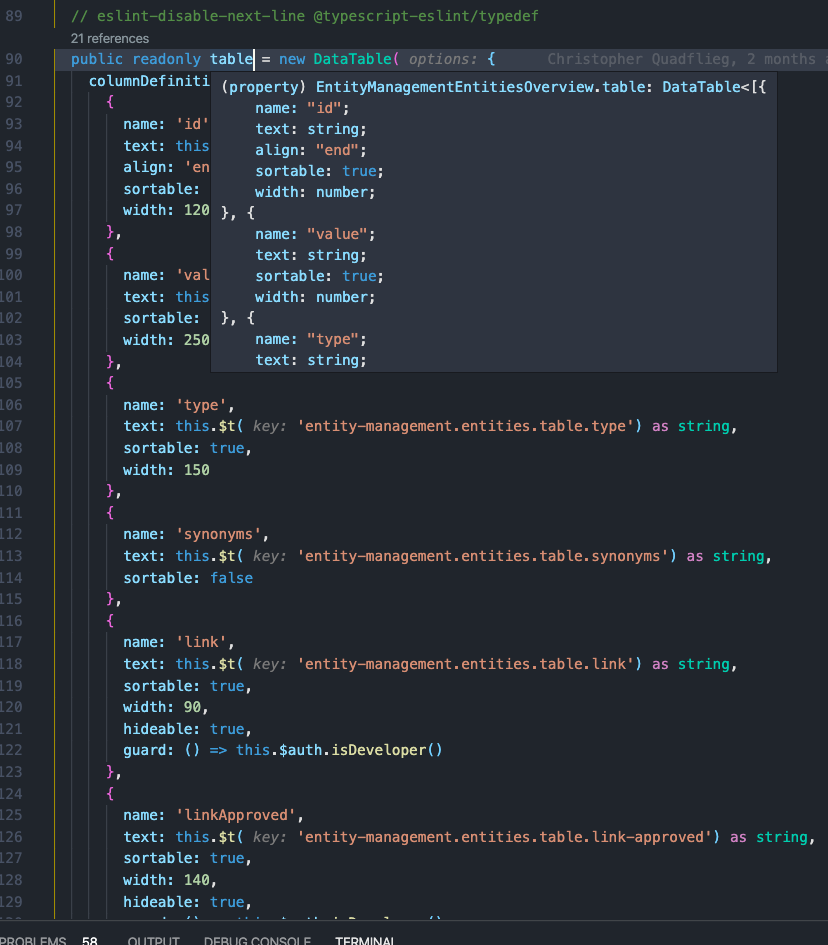
@Component
export default class MyVueComponent {
  // eslint-disable-next-line @typescript-eslint/typedef
  public readonly table = new DataTable({
                    // ~~ dont want it to be any or unknown
    columnDefinitions: [
      {
        name: 'id',
        text: this.$t('table.id'),
        align: 'end',
        sortable: true,
        width: 120
      },
      {
        name: 'value',
        text: this.$t('table.value'),
        sortable: true,
        width: 250
      },
      {
        name: 'type',
        text: this.$t('table.type'),
        sortable: true,
        width: 150
      },
      {
        name: 'synonyms',
        text: this.$t('table.synonyms'),
        sortable: false
      },
      {
        name: 'link',
        text: this.$t('table.link'),
        sortable: true,
        width: 90,
        hideable: true,
        guard: () => this.$auth.isDeveloper()
      },
      {
        name: 'linkApproved',
        text: this.$t('table.link-approved'),
        sortable: true,
        width: 140,
        hideable: true,
        guard: () => this.$auth.isDeveloper()
      },
      {
        name: 'modifiedAt',
        text: this.$t('table.modified-at'),
        sortable: true,
        width: 150,
        hideable: true
      },
      {
        name: 'textAdUsage',
        text: this.$t('table.text-ad-usage'),
        sortable: true,
        width: 150,
        hideable: true
      },
      {
        name: 'group',
        text: this.$t('table.entity-group'),
        sortable: true,
        width: 140,
        hideable: true
      },
      {
        name: 'relation',
        text: this.$t('table.relation-to'),
        sortable: true,
        width: 170,
        hideable: true
      },
      {
        name: 'standalone',
        text: this.$t('table.standalone'),
        sortable: true,
        width: 180,
        hideable: true
      },
      {
        name: 'textAdAlternative',
        text: this.$t('table.text-ad-alternative'),
        sortable: true,
        width: 170,
        hideable: true
      },
      {
        name: 'actions',
        text: this.$t('global.table.header.actions'),
        width: 120
      }
    ]
  });
}
eslint blames me about to add a typedef to this line.
- I dont want to write the complete typedef to
tableand want the behaviour as not writing a typedef. - I want to signalise other developers that this is fully intended and want the behaviour.
So I can still profit of it when calling a function of it likethis.table.setColumnVisibility('link', false);, were the first parameter is an union string literal of all possible hidden columns!
We cant create a type or interface with the name infer and use it as type definition
Therefore this will not be a breaking change!
Checklist
My suggestion meets these guidelines:
- This wouldn't be a breaking change in existing TypeScript/JavaScript code
- This wouldn't change the runtime behavior of existing JavaScript code
- This could be implemented without emitting different JS based on the types of the expressions
- This isn't a runtime feature (e.g. library functionality, non-ECMAScript syntax with JavaScript output, etc.)
- This feature would agree with the rest of TypeScript's Design Goals.